Let’s Talk About Peps

A guest blog by Claire Childs

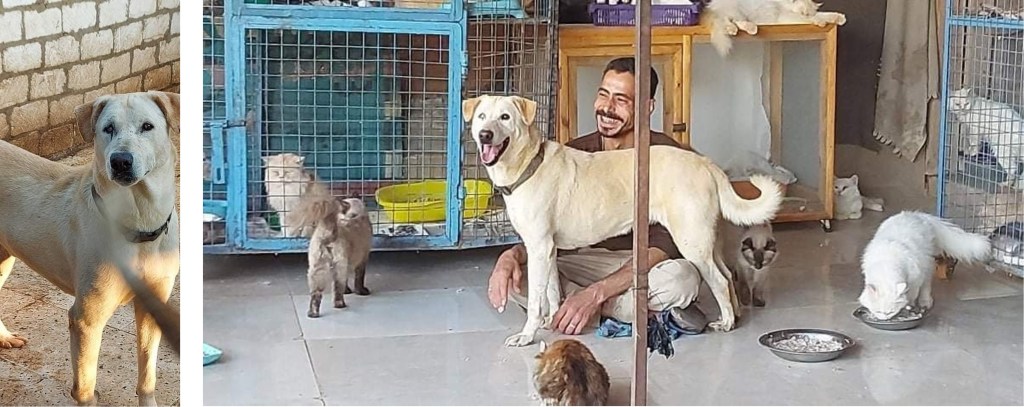
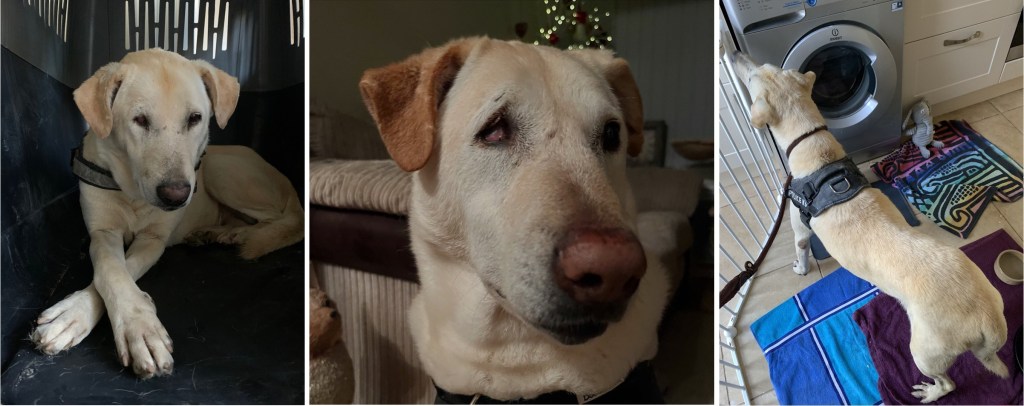
Peps’s story began in Egypt. He had been found with his brother at approximately 6 months old on the street by volunteer rescuers from the ESMA Shelter (Egyptian Society for Mercy to Animals). Sadly the rest of his family had been poisoned and did not survive. Initially upon arriving at the shelter, it wasn’t identified that Peps was blind as he coped so well, using his brother as his eyes, After a few months his brother got adopted and Peps’s disability became more apparent. He struggled at times and was bullied by some of the bigger, stronger dogs. He spent time in the cat shelter and looks extremely happy there!

Peps was identified by the English charity Miracles Mission as a dog they would like to try and help. Miracles Mission have identified many disabled and sick animals who do not cope well in shelters around the world. They started searching for a home for Peps and after contacting them, I arranged for him to come over as a foster dog and he arrived in June 2021. It wasn’t long before I decided he fitted in so well that I adopted him. 

Peps had a really long journey by plane to France, then by road, across the channel to England. He travelled with his friend Selim, who was on his way to his new home with my friend Martine! At some point they ended up getting switched in their crates but fortunately we got them round the right way! Selim has only three legs, so it was fairly easy to see they were in the wrong crates!

It was very late in the evening when Peps finally arrived. He was very quiet and shut down. He didn’t want to come out of his crate or eat, so I left him to decompress, sitting nearby and talking quietly to him. It must have been such a shock for him.

The next morning, I coaxed him out of the crate and he ventured into the garden to go to the toilet. He moved very carefully and slowly, almost mapping out where he was with every step. Very quickly he learned where the door was, where the step was, where the water bowl was….. It didn’t take long for him to know exactly where everything was. He does this whenever we go somewhere new and will take some time to just walk around slowly and map his surroundings.

Peps adapted quickly to his new surroundings, but in reality it took months really for him to feel comfortable and know that he was HOME. He had probably never heard a washing machine before, never experienced walking in the rain before, never felt or heard leaves falling from the trees – all of the things that we take for granted.  As he couldn’t see any of these things some were very scary for him. He rarely showed that he was frightened or anxious so I had to observe and try to pick up on some of his behaviours and mannerisms to understand what made him anxious.

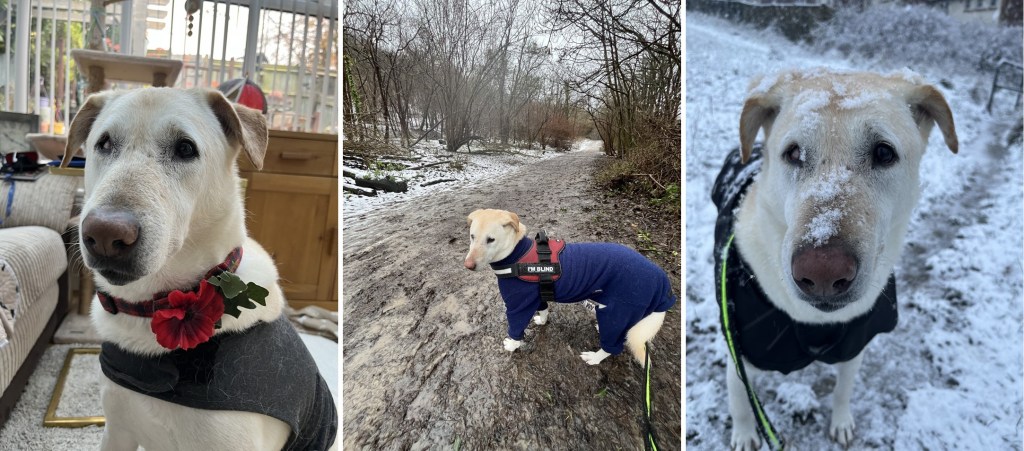
Initially he was quite frightened outside as well and if we managed to walk about 50 metres along a path near the house, it was a success! Slowly over time we got a bit further and a bit further.

Just before Peps arrived it was discovered that he was suffering from Erlichia, a tick borne disease. He received treatment for this which was successful but was just another challenge for him to arrive with. Fortunately hiding tablets from him is quite easy 🙂

After his initial vet checkups it was also identified that he had luxating patella on both of his back knees. He was assessed by a specialist and determined that he did not need an operation as he coped well with this, but physio, strengthening exercises and walking would help to strengthen. He also has some arthritis in his front leg joints. 

All of these things were a challenge but with a rescue dog you never really know their full back story, so just have to deal with things as they come up.

The only real difference I have found having a blind dog really is teaching him different things to assist him. Peps has learned “up” and “down”, so he can walk up and down steps / kerbs etc without banging his legs; “left” and “right” so he can navigate around and I also taught him “tree” as his obstacle word so he knows something is in front of him. He navigates around the house really well, and can always find the food cupboard and the fridge! I can move things around but do tend to try and keep things the same if I can. He walks off lead in fields and in the woods quite happily and sometimes leads the way back home if he is tired!

As he has become more settled at home, he also likes to shout at delivery drivers a lot! This is because he feels so comfortable and settled at home, he feels anxious if something threatens that safe feeling at home.

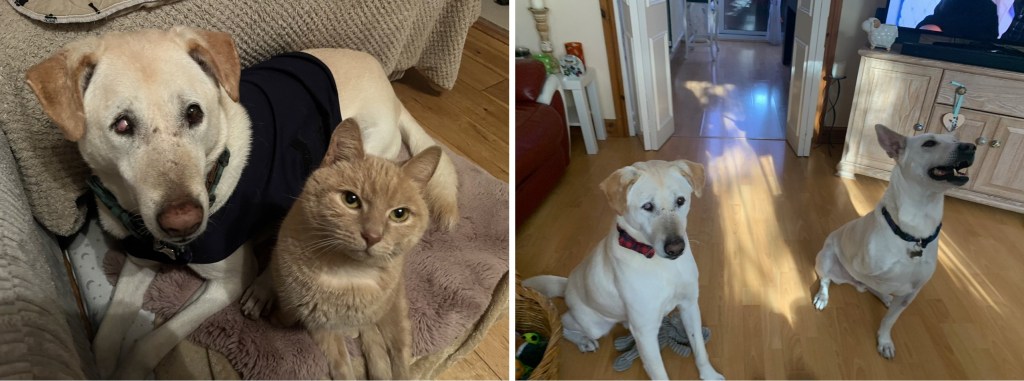
Peps has now been with me for 3.5 years, and I have honestly never met a dog so balanced before. He is so calm and gentle, lives happily with the cats and truly takes everything in his stride and adapts amazingly. He has been a registered Pets as Therapy Dog for two years and every week we visit a local residential home to spend time with the residents. As he cannot do a lot of physical exercise, this gives him mental stimulation and he loves the fuss and attention he receives.

It’s been lovely to keep in touch with the wonderful volunteers who cared for him in Egypt and share photos with them about his life now. They really did an amazing job, after he had suffered such trauma, to be able to re home such a balanced and happy dog so I’m very grateful to them.

Let’s Talk About Marilyn

A guest blog by Megan Rowlands

Hello there! We are Megan and Abby, and we share our home with our three amazing Spanish rescue sighthounds: Sally, Brisa, and Marilyn. Megan spent time growing up in Spain, and witnessed the heartbreaking animal welfare situation there. Podencos and Galgos are used for hunting due to their strong natural prey drive, and are often abandoned, tortured, or even killed when they are no longer needed. It’s estimated that around 50,000 hunting dogs suffer from this cruelty each year. Unlike other domestic breeds, hunting and working dogs in Spain don’t have the same legal protections, so they rely on rescue organisations for care and advocacy. Marilyn was rehomed to us through a wonderful UK-based charity called Project Galgo, and they have more information about the terrible challenges faced by Spanish hunting dogs here

Marilyn’s story

Marilyn’s journey hasn’t been easy. She was hit by a car in Spain at less than 1 year old, and left to die alone at the side of the road. She suffered a broken spine and would never walk again. Thanks to the incredible veterinary team at Fundacion Benjamin Mehnert hospital, Marilyn received the care she needed to recover. They even equipped her with a doggy wheelchair to get her back on her feet, and adorned her with the title ‘the earthquake on wheels’! Despite her incredible spirit, Marilyn was still waiting for a loving home. When we saw footage of her dramatic rescue from the roadside, and videos of how she’d progressed in the hospital, we couldn’t bear the thought of her being overlooked. So in November 2023, after a year of her waiting, we welcomed Marilyn into our family!

Why we decided to adopt a dog with disabilities

We had never considered having a dog with disabilities before Marilyn came along. Marilyn is rear-end paralysed and incontinent, so she uses her forelimbs to pull herself around (with help from a doggy wheelchair outside). We also manually express her bladder and bowels. Although we now know this isn’t that scary, the reality is that most people are put off by it. We live a quiet, simple life (some might say boring, but we love it!) with one of us working from home and we knew that we could give Marilyn the support she would need.

How does having a dog with disabilities differ?

Marilyn’s needs are not much different to that of any dog. The difference is how we fulfil those needs. For example, when we let Sal and Brisa out to go to the toilet in the garden, we take Marilyn to the bathroom to express her bladder. We all go out for a walk together, and Marilyn goes on her wheels. She doesn’t need a special diet, but we make sure that she has joint supplements, and we keep an eye on her weight so that she’s not putting unnecessary pressure on her forelimbs. She loves to play with Brisa, and her disability doesn’t stop her from winning tug or bitey-face, although Brisa is a bit mean sometimes and will run upstairs knowing that Marilyn can’t chase her!

We’ve also learnt to be extra-mindful of keeping the house clean and tidy, so that she doesn’t pick up any infections because her feet drag on the floor, and that she doesn’t get stuck on anything around the house.

If she wants to do something, she’ll either find a way to do it or she’ll tell us what she wants. Going up stairs is the only thing she can’t do on her own, so she’ll stand at the bottom step and rest her head on it to let us know that’s where she wants to go! It’s important to keep an eye out for communication cues, so that we know when she wants help. But this is much the same for any animal! Once these things become normal routine, it’s no additional effort to live a safe, clean and fun life with her!

What have the challenges been?

The first couple of weeks with Marilyn were hard to adjust to. We’d never expressed an animal’s bladder or bowels before, and were constantly worried that we weren’t doing things right or that we weren’t giving her what she needed. We desperately didn’t want to let her down. I remember looking at her little wonky body and crying at the sheer tragedy of it all. It was hard not to look at her and be affected by the hand she’d been dealt. But it got easier. We began to find lightness and humour in things. Marilyn is very cheeky and funny and she never feels sorry for herself, so we learnt not to. The more we did things, the more they became part of normal life. We followed a couple of helpful pages on social media, which developed our knowledge and allowed us to feel less alone. There really weren’t many sources of help out there, and at times it felt like we were the only people on the planet who had a dog like ours. It’s hard to know what’s ‘normal’ for a dog who isn’t ‘normal’! But thankfully there are more and more resources out there now to help (just like Woofability!), and more communities of very special fellow carers to join!

Another interesting challenge is people’s perceptions. Marilyn attracts a lot of attention, and her situation is both unusual and impressive. A common reaction is sympathy, and we often get people saying things like ‘poor thing!’. Whilst we know that comments like this come from a good place, we always advocate for Marilyn to explain why she wouldn’t want sympathy. We remind people that she’s very happy, she doesn’t know she’s different, and she effectively walks everywhere in a handstand, which is a darn sight more impressive than what you or I can do! As with humans, the language we use around disability is important in order to change perceptions, and we always focus on what she can do (impressively well!), rather than what she can’t. We are also determined to change misconceptions about disabled animals in the veterinary and wider animal welfare world, specifically around the quality of life they can have. Marilyn and many others prove that animals with disabilities can live fulfilled, happy and healthy lives, if just given the chance.

Why you should consider a special dog!

We already know that dogs are wonderful, but dogs with disabilities are extra-wonderful! They will surprise you, fill you with joy at watching their zest for life, and teach you valuable lessons. The bond between you is a powerful one, and you develop a unique partnership and we wish we had known about how wonderful having a dog with disabilities is sooner!

We would like to thank Megan and Abby for sharing Marilyn’s amazing story xxx

When Your Dog Becomes Deaf

by Linda GoodmanI’ve had dogs all of my life, but it is only in the last four years that I discovered what life was like living with a dog that has lost their hearing.

The late Teddy Bichon had phenomenal hearing and was always highly responsive when I spoke to him. In fact, he always liked a good two-way conversation. It was only once he turned 13 that I noticed a subtle difference in his behaviour.

He had started to sleep for longer and didn’t seem disturbed by noises that would once have seen him leap out of bed to investigate. When I called him, it was as if he was ignoring me – he could be a stubborn little character at times. It was only when I spoke more loudly that I would get a response, and that’s when I realised that his hearing was failing.

I checked his ears and they looked clean and I couldn’t spot any swellings around his ear, so I took him along to get checked by my vet, just to make sure there wasn’t any underlying cause for his hearing loss like debris deeper in his ear canal, or a possible ear infection. The vet examined him, shrugged his shoulders and just told me it was old age. I felt sad that my beautiful little man was losing his hearing, but quickly realised that it bothered me more than it bothered him.

Luckily at that point, although he had cataracts, he could still see reasonably well so I had to try and communicate with him using hand signals – not the easiest thing to teach a dog of his age. It was at this point that I wished I’d taught him hand signals when he was much younger.

Life carried on as normal, but because he couldn’t hear me when out on walks he could no longer go off lead for his own safety, except in secure locations. However, I didn’t need to tell him when it was time for breakfast, lunch or dinner, or when there was a treat on offer, as his sense of smell was as sharp as ever.

A year further down the line and Teddy had become completely deaf. I tried to look on the bright side. No longer would there be hysterical barking when anyone knocked on the door. No longer would he be woken up by Daisy’s barking every morning at 6am. He was happy in his own little world, and as long as he could see me, he felt safe and loved.

Dog deafness can happen for a variety of reasons, which is why it’s always important to get your dog’s ears checked by a vet if you notice a change. Some breeds are more prone to it than others and of course some dogs are born deaf.

When you’re with your dog every day, their hearing loss can be very subtle at first and you may not even notice it. Dogs are very clever and manage to adapt to their new circumstances pretty quickly.

Teddy’s deafness didn’t diminish our relationship at all, and while I had to adapt to his changing circumstances, he lived a happy and fulfilling life full of cuddles, good food and oodles of love until he passed away in October 2023 at the age of 16.

You can find out more about deafness in dogs, and how to help them, on our ‘Deafness’ page.

Fostering & Volunteering

by Linda GoodmanSomething you may not have considered before, or even be aware of, is fostering a dog. There are so many benefits for the dogs involved and for the fosterers.

Firstly, if you love the idea of having a dog but are not sure if your lifestyle is suited, it’s a way of seeing what it’s like to be a full time dog owner without the long term commitment. Far better to do this, than to buy a puppy and then discover you’ve made a mistake.

Secondly, it’s well established that dogs surrendered to rescues don’t do as well when kennelled as they do in foster homes. And it’s hardly surprising. These poor dogs suddenly find themselves institutionalised in kennels, a strange place that doesn’t look or smell like home, along with lots of other stressed dogs barking and crying. Don’t get me wrong, the kennel staff do their best to make sure every dog in their care is well-looked after, but with rescues full to bursting, it’s just not always possible to devote as much time to every dog as they would want. And let’s face it, nothing can take the place of a warm cosy bed in a home with a garden, where a dog can receive the one-to-one care, and the love and affection they crave.

Fostering is genuinely a lifeline for pets in need. But be warned, don’t be surprised if you fall in love with your foster dog and want to adopt them. It’s affectionately known as being a ‘failed fosterer’ and I’ve been one on numerous occasions.

What sort of dog could you foster?

There are dogs of every imaginable breed and age, including puppies, who need foster homes right now. Fostering is a brilliant solution for people who have never had a dog before, as well as for people who have lots of experience with dogs. It’s particularly beneficial for older, retired people who enjoy the company of dogs, or for people who like to go on holidays during the year and worry about leaving their best friend behind in kennels or with a dog sitter.

The rescue will usually provide you with everything you need to foster a dog, including food if required, and they’re always on hand with advice if you need it. The length of time you can foster for will depend on the dog’s circumstances and how quickly the right home can be found for them, and of course how long you are available or comfortable fostering for.

Helping people by helping their dogs

Sometimes fostering is used to help someone who has become homeless or they need to flee domestic abuse. These are people who are afraid to leave their dog behind and so put off leaving their abuser. Sadly most refuges for those fleeing domestic abuse don’t take pets, but with rescues offering foster spaces for their dogs, it can end up being a happily ever after when that person eventually finds a new permanent home, and they can be reunited with their beloved dog. One shelter that works with people experiencing homelessness, including those with pets, is St. Mungo’s.

Another reason fosterers are needed, is when people become ill and need to go into hospital for a few weeks but they have nobody to look after their dog. It’s incredibly rewarding being a fosterer, knowing that you’ve not only helped a dog in need, but a person as well.

The saddest reason for a dog needing a foster carer is when their owner has died, and no other family members are able to take the dog who is grieving the loss of their owner and their routine.

You can find out more about becoming a fosterer by contacting your local rescue. They’ll be so relieved to hear from you because there are just so many dogs today that need to get out of kennels and back into homes. You’ll really be a lifesaver, and that’s something you can feel really good about.

Volunteering

If you love the idea of having a dog, but just don’t have the time or space for a long term commitment, something else to consider is becoming a volunteer for your local rescue. That way, you can be around dogs as much as you like, and you’ll be helping the dogs as well as the rescue. Other than the large, well-funded rescue charity chains, there are thousands of small, independent rescues that rely on the good will of volunteers for things like fundraising and dog walking. They often don’t have paid staff and are 100% dedicated to saving the lives of dogs in need. Some even specialise in certain breeds. In becoming a volunteer you’ll be doing so much good in your spare time and will find it very rewarding.